The White last name origin has a long history in England, Scotland, and Ireland. It is one of the well-known English family names.
The surname has a simple meaning, but its story is rich and interesting. It can tell us about old family names, language, culture, and the way people lived many years ago.
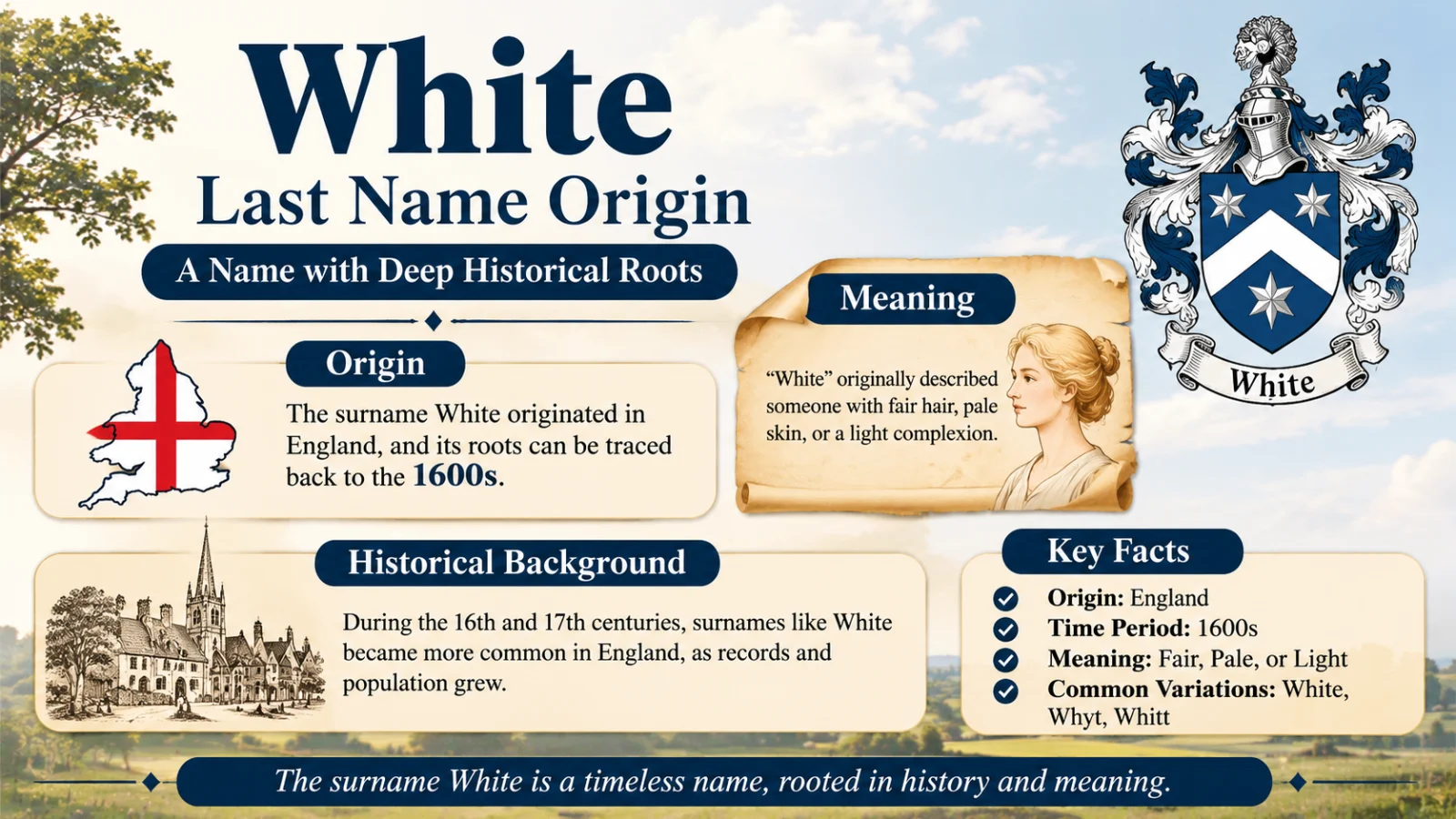
The last name White comes mainly from the Old English word hwīt, which means “white.” In the past, people often received nicknames based on their looks.
Someone with white or very fair hair, or a pale complexion, might have been called White. Over time, this nickname became a family name.
But not every White family has the same roots. Some families have English, Irish, or Scottish roots. Others may have a surname that was changed from a similar name in another language.
Many people search for the White surname to learn about their family tree, heritage, and ancestors. They may also want to know if their family name has a link to a certain place or culture.
In this guide, we will explore the meaning, history, origins, spelling forms, and family roots of the White surname. We will also look at related last names and ways to research your own White family history.
What Does the Name White Mean?
The surname White mainly means “white” or “fair.” It comes from the Old English word hwīt. In early English communities, it was likely used as a nickname for a person with white hair or a pale complexion. Later, the nickname became a family name.
The name also has other possible roots. Some White families may have links to Irish or Scottish Gaelic names. Others may have roots in place names or European surnames that were translated into English.
White is a descriptive surname. It began as a word used to describe a person or a feature. It does not have one fixed meaning for every family.
The surname also does not tell us a person’s character or personality. Ideas such as honesty, peace, and purity may be linked to the color white in some cultures, but they are symbolic ideas, not proven traits of people who carry this surname.
1. 🏰 The English Origin of the White Last Name
The best-known origin of the White surname is English. It began as a descriptive nickname. People in old English communities often used simple words to describe a person’s looks, job, or place of birth.
The word hwīt was used in Old English. It later developed into forms such as white and wit in Middle English. These words helped form the surname we know today.
A person with very fair hair or a pale complexion may have been called White. The name could then pass from one generation to the next.
The surname appears in records from medieval England. Early forms include spellings such as Wite and Whyte. These spellings show how names changed over time.
The English origin is the main source of the surname, but it is not the only one. Family history must be checked with records to find the roots of a specific White family.
2. 🍀 The Irish Roots of the White Surname
The White surname also has a long link to Ireland. Some Irish families adopted White as an English form of older Gaelic family names.
The Gaelic language has words for white and fair. Two important words are bán and fionn. Both can relate to the idea of being fair or light.
Some Irish families used English names when records, schools, churches, or public offices used English. This led to changes in the spelling and form of family names.
The Irish form de Faoite is also linked to the English surname White. It is one example of how a name can change as it moves between languages.
Not every Irish person with the White surname comes from the same family line. Some may have English roots, while others may have Gaelic roots.
If your family has Irish roots, old church records, birth records, and family papers may help you learn more.
3. 🏴 The Scottish History of the White Last Name
White is also found in Scotland. Scottish families may have received the name through English-language nicknames or through the translation of Gaelic names.
The spelling Whyte is strongly linked with Scottish and English surname history. It is a known form of White and appears in older family records.
In some Scottish Gaelic names, the words bán and fionn refer to fair or white features. These words may help explain why some families came to use White as an English surname.
Scotland has a long history of movement between regions. People moved for work, trade, marriage, and land. As they moved, their names could change in spelling or form.
This means that two Scottish families named White may not share the same direct ancestor.
If you are tracing a Scottish White family, look for records from the exact town, parish, or county where your ancestors lived. A surname alone cannot prove a family connection.
4. 📜 How the White Surname Began
Many English surnames began as nicknames. Before family names became fixed, people often used short descriptions to tell one person apart from another.
For example, a village might have had two men with the same first name. One could be known by his hair color, while the other might be known by his job or home.
A person called White may have had very fair hair or a pale complexion. The name helped people identify him.
Later, children and other family members began using the same surname. It became a family label instead of a personal nickname.
This change took place over many generations. Written records helped make family names more stable.
The White surname was already in use in medieval England. Historical sources record early forms of the name in the 11th and 12th centuries. Some early examples include Hwita, Wite, and le White.
5. 🌍 The White Surname Around the World
The White surname is now found in many parts of the world. It is common in English-speaking countries, such as the United States, the United Kingdom, Canada, Australia, and New Zealand.
Migration played a major role in spreading the name. People from England, Ireland, and Scotland moved to other countries for work, land, trade, and new chances.
The name also became common in the United States through different family histories. Some White families arrived from Britain and Ireland. Others adopted White as an English version of a surname from another language.
This is important because the same spelling does not always mean the same family origin.
For example, a family called White in the United States may have English roots. Another White family may have Irish, Scottish, German, or Eastern European roots.
The surname is also found among African American families. Their family histories may connect to many different events and communities, including the history of slavery, emancipation, and later migration.
The White surname is international today, but each family’s story is unique.
6. ✨ White Last Name Origin and Its Different Spellings
Family names did not always have one fixed spelling. In the past, many people could not read or write. Clerks and record keepers often wrote names as they heard them.
This is one reason why White has several spelling forms.
Here are some known forms and related spellings:
- White: The most common modern English spelling.
- Whyte: A traditional spelling found in Scotland and England.
- Whitt: A related spelling found in English surname records.
- Whitta: A less common form linked to the wider White name group.
- Witte: A spelling found in some European name histories.
- Witt: A surname that may have separate Germanic roots.
- Witts: A related spelling found in historical surname lists.
- Wythe: A historical spelling listed among forms related to White.
These forms do not all have the same history. Some are spelling variants, while others may have separate roots.
For example, the German surname Weiss means “white.” It may look different, but it has a similar meaning. French families may have the surname Blanc, which also means “white.”
If you find an old family record with a different spelling, do not assume it belongs to a different family. Compare dates, places, and family members before drawing a conclusion.
7. 🧬 What Does the White Surname Tell Us About Family Heritage?
A surname can offer clues about family history. It can point to a language, region, or old family tradition.
The White surname may suggest English roots. It may also point to Irish or Scottish history. In some cases, it may come from a European name that was changed into English.
But a surname is only one part of family heritage.
Two people with the last name White may have no close family link. Their ancestors may have lived in different countries and spoken different languages.
For example, one White family may have lived in England for many generations. Another may have roots in Ireland. A third may have come from Germany and changed the family name from Weiss to White.
To learn about your own family, you need more than the surname. You can look at:
- Birth and death records.
- Marriage records.
- Old family letters.
- Church records.
- Census records.
- Immigration papers.
- Military records.
- Family photographs.
These records can help you build a family tree.
You can also ask older family members about their parents and grandparents. Their stories may give you names and places to search.
Remember: The White surname gives you a starting point, not a complete family history.
8. 💎 Famous People With the White Last Name
Many well-known people have the surname White. They come from different fields, such as music, sports, film, science, and public life.
Here are some examples:
- Barry White: An American singer known for his deep voice and romantic music.
- Betty White: An American actress and comedian known for her long career in television.
- E. B. White: An American writer known for books such as Charlotte’s Web.
- Walter White: An American chemist and civil rights leader who served as the head of the NAACP.
- Jack White: An American musician and songwriter known for his work with The White Stripes.
- Shaun White: An American snowboarder and skateboarder who won Olympic gold medals.
- Vanna White: An American television personality known for the game show Wheel of Fortune.
- Reggie White: An American football player known as one of the great defensive players in the sport.
- T. H. White: A British writer best known for his books about King Arthur.
- Mina Loy: Not a White surname bearer, but an example of why family research must focus on verified records rather than name-based assumptions.
These people show how widely the surname is used. They do not all come from one family line.
A shared surname does not prove that two people are related. You need family records to show a real connection.
9. 🌿 Related Surnames That Mean White
Many languages have their own words for the color white. Some of these words became family names.
This makes it possible to find surnames with meanings close to White in other countries.
Here are ten examples:
1. Weiss
Meaning: A German surname meaning “white.” It may be linked to a family with German-speaking roots.
2. Weiß
Meaning: The German spelling of Weiss, with the letter ß. It has the same basic color meaning.
3. Blanc
Meaning: A French surname meaning “white.” It may have started as a nickname.
4. De Wit
Meaning: A Dutch surname meaning “the white.” It is a common Dutch form.
5. De Witte
Meaning: A Dutch or Flemish surname meaning “the white.” It is linked to the same color idea.
6. De Witt
Meaning: A Dutch family name related to the word for white.
7. Białas
Meaning: A Polish surname connected to the Polish word for white.
8. Belec
Meaning: A Slovenian surname linked to the idea of white or fair.
9. Bain
Meaning: A Scottish surname connected in some cases to the Gaelic word bán, meaning white or fair.
10. Finn
Meaning: A surname linked in some Irish and Scottish name histories to fionn, meaning fair or white.
These surnames are related by meaning or language, but they do not all share one family origin. A person named Weiss is not automatically related to someone named White.
10. ❤️ White as a Symbol in Names and Culture
The color white has many meanings in different cultures. It is often linked to light, peace, hope, and new beginnings.
This can make the White surname feel special to some families. However, these are cultural ideas about the color. They are not the original meaning of every White family name.
In some cultures, white is worn at weddings. It may stand for joy, purity, or a fresh start.
In other cultures, white is used at funerals. It can stand for peace, respect, or a spiritual journey.
White can also be linked to snow, clouds, light, and clean spaces. These ideas may give the name a calm or bright image.
Still, it is important to separate symbolism from history.
The surname White mainly began as a descriptive name. It was often linked to a person’s fair hair or pale complexion. Some families have other origins.
If you carry this surname, you can enjoy its cultural meaning while also exploring the real story of your ancestors.
11. 🔎 How to Research Your White Family History
Do you have the White surname? Would you like to know where your family came from?
You can start with a few simple steps.
Step 1: Talk to Your Family
Ask parents, grandparents, aunts, and uncles about your family history.
Try to learn:
- The names of your grandparents.
- The places where your family lived.
- The names of older family members.
- The languages your family spoke.
- Any stories about moving to another country.
Write down what you learn.
Step 2: Look for Old Family Records
Search for birth, marriage, and death records. These can help you find names and dates.
Old letters, photographs, and family papers can also offer useful clues.
Step 3: Search Census Records
Census records can show where people lived at a certain time.
They may include family members, ages, places of birth, and jobs.
These records can help you follow a White family through different generations.
Step 4: Check Immigration Records
If your family moved from one country to another, immigration records may help.
They can sometimes show a person’s birthplace, travel date, and family members.
Step 5: Check Different Spellings
Do not search only for White.
Try forms such as Whyte, Whitt, and other spellings found in your family records.
Names could change when people moved or when officials wrote them down.
Step 6: Use Trusted Family History Websites
You can explore websites such as:
- FamilySearch
- Ancestry
- Forebears
- Behind the Name
Compare the information you find with original records whenever possible.
Step 7: Build Your Family Tree
Write down each family member and how they are related.
Start with yourself, then add your parents, grandparents, and older generations.
Keep a note of where each fact came from. This helps you avoid mixing up people with the same name.
Can DNA Testing Help?
DNA tests may help you find genetic relatives and learn about broad ancestry patterns. But they cannot prove that every person with the surname White belongs to your family.
Use DNA results with family records and other evidence.
12. 🌟 Interesting Facts About the White Last Name
The White surname has several interesting facts. Its history connects language, migration, and family traditions.
Here are ten facts worth knowing:
- It has Old English roots: The name comes mainly from hwīt, meaning white.
- It began as a nickname: It was often used to describe someone with fair hair or a pale complexion.
- It has Scottish forms: Whyte is a well-known spelling linked to the surname.
- It has Irish connections: Some Irish families adopted White from Gaelic family names.
- It appears in old records: Early forms of the surname date back to medieval times and earlier name records.
- It has European links: Weiss and Blanc are examples of surnames with similar meanings.
- It spread through migration: Families carried the surname to North America, Australia, and other parts of the world.
- It has more than one origin: Not every White family shares the same history.
- It can be a translated surname: Some families changed a European surname meaning white into its English form.
- It is still widely used: White remains a familiar surname in many English-speaking countries.
These facts show why surname research can be so interesting. One simple name can have many stories behind it.
FAQs About White Last Name Origin
1. What is the White last name origin?
The White surname mainly comes from England. It comes from the Old English word hwīt, meaning white. It was often a nickname for someone with fair hair or a pale complexion.
2. Is White an English or Irish last name?
It can be both. White has a strong English origin, but some Irish families adopted it from Gaelic names linked to the words bán and fionn.
3. Is the White surname Scottish?
Yes. White and its spelling form Whyte are found in Scottish family history. Some Scottish families also have links to Gaelic names.
4. Does everyone with the White surname have the same ancestors?
No. Many families have the same surname but different family roots. The name alone cannot prove that two people are related.
5. What does the White surname mean?
It mainly means “white” or “fair.” It was often used as a nickname for someone with fair hair or a pale complexion.
6. What are some other spellings of White?
Some known forms include Whyte, Whitt, Whitta, Witte, Witt, Witts, and Wythe. The history of each form may be different.
7. Is White a common last name?
Yes. White is a familiar surname in the United States, the United Kingdom, Ireland, Canada, and Australia. Its exact ranking can change by country and year.
Conclusion:
The White last name origin has a rich history that goes back to Old English. The name mainly comes from the word hwīt, which means “white” or “fair.” It was often used as a nickname for someone with fair hair or a pale complexion.
Over time, the name became a family surname. It spread through England, Ireland, Scotland, and many other parts of the world. Some families also have links to European names such as Weiss and Blanc.
The White surname has many spelling forms and family stories. But not every person with this name shares the same ancestors.
If your last name is White, take time to explore your family tree. Talk to older relatives, check old records, and learn about the places your ancestors called home.
Your surname is more than a name. It can be the start of a story about your family, roots, and past.
Research Sources
- FamilySearch – White Family History
- Behind the Name – White Surname
- Oxford Dictionary of Family Names in Britain and Ireland
- Forebears – White Surname History
- Ancestry – White Family History

Discover more famous authors, their biographies, and literary achievements at NameBloomz.